2010 NYT Small Business Summit
This was the official website for the 2010 NYT Small Business Summit. The content below is from the site's 2010 archived pages.
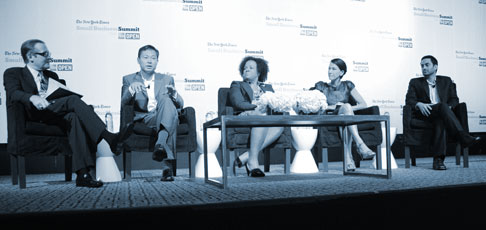

Please check back for agenda updates, including announcements of speakers and moderators. Note that breakout session topics are subject to change.
7:30 a.m.
Registration
7:30 a.m. – 8:15 a.m.
Continental Breakfast
8:15 a.m. – 8:30 a.m.
Welcome & Introductions
8:30 a.m. – 9:30 a.m.
Surviving on the Front Lines: "You're the Boss," the Art of Running a Small Business Panel Discussion with Loren Feldman, Small Business Editor at The New York Times, and contributors Jay Goltz and Paul Downs
9:30 a.m. – 10:45 a.m.
High-Level Panel: How Innovation Drives Business in Challenging Times
10:45 a.m. – 11:15 a.m.
Coffee Break in the Local Resource Café and The American Express Business Zone brought to you by American Express OPENsm
11:15 a.m. – 12:15 p.m.
Morning Breakout Sessions
Leveraging the Digital Space to Grow Your Business
Marketing: Building a Brand
Speed Networking — Brought to you by American Express OPENsm.
Serial Entrepreneurs
Grow Your Business: The Nuts and Bolts of Running Your Company
You can also visit the Local Resource Café and The American Express Business Zone brought to you by American Express OPENsm
12:15 p.m. – 12:45 p.m.
Break
12:45 p.m. – 1:15 p.m.
Lunch
1:15 p.m – 2:15 p.m.
Luncheon Keynote Session
Jerry Greenfield, Co-Founder, Ben & Jerry's Homemade, Inc.
2:15 p.m. – 2:30 p.m.
Break
2:30 p.m. – 3:30 p.m.
Afternoon Breakout Sessions
Leveraging the Digital Space to Grow Your Business
Marketing: Building a Brand
Speed Networking — Brought to you by American Express OPENsm.
Serial Entrepreneurs
Grow Your Business: The Nuts and Bolts of Running Your Company
You can also visit the Local Resource Café and The American Express Business Zone brought to you by American Express OPENsm
3:30 p.m. – 3:45 p.m.
Break
3:45 p.m. – 4:45 p.m.
Closing Keynote Session
Robin Chase, Founding CEO, ZipCar and GoLoco
4:45 p.m. – 5:45 p.m.
Networking Cocktail Party

Morning Sessions: 11:15 a.m. – 12:15 p.m.
Leveraging the Digital Space to Grow Your Business
- Experts who have created new platforms as well as utilized existing platforms in novel ways share insights into how to incorporate all aspects of digital media to create exposure and build your brand among existing customers and new customers. This session will provide you with tools to increase traffic coming through your — real and virtual — doors, measure and grow the effectiveness of your digital strategy, and gain traction in the online community.
- Moderator: Steve Rubel, SVP Director of Insights of Edelman Digital
- Scott Heiferman, Founder of Meetup.com
- Maria Baugh, Co-Founder and Co-Owner, Butter Lane
- Daniel Lubetzky, Founder, KIND Healthy Snacks
Marketing: Building a Brand
- Broaden your marketing perspective in this discussion of emerging marketing tactics and strategies. Learn to leverage your relationships with customers and create meaningful dialogue that will generate brand advocacy. This session will provide you with tools to create a breakthrough marketing strategy that will help you retain and grow your customer base.
- Moderator: Valeria Maltoni, Director of Strategy of Powered, Inc.
- Christiane Lemieux, Founder and Creative Director of DwellStudio and DwellStudio for Target
- Bill Carter, Founder of Fuse
- Brian Halligan, CEO and Co-Founder of HubSpot
- Sean Whiteley, VP, Product Marketing of SalesForce.com
Speed Networking – Brought to you by American Express OPENsm
- Take advantage of this opportunity to meet like-minded entrepreneurs and small-business owners during this interactive Speed Networking session designed to build a pipeline of connections that can help you grow and manage your business. Connect with potential new clients, suppliers or business partners. Find solutions to current business challenges. Uncover opportunities. Or just practice your elevator pitch. It's amazing what you can accomplish in five minutes.
Serial Entrepreneurs
- Serial entrepreneurs have the confidence to achieve, but also the resilience to try again after failure. As they pursue the thrill and challenge of launching one enterprise after the next, these serial entrepreneurs learn how to identify opportunity, how to make their mark, and how to sell businesses and make their exit to the next venture. As our experts share how they've overcome the challenge of starting over again and again, this session will help you manage your own opportunities and risks.
- Moderator: Penny Pickett, Associate Administrator of Entrepreneurial Development, U.S. Small Business Administration
- Alex Mashinsky, CEO, Founder of LimoRes
- Mitchell York, Founder and CEO of Executive-to-Entrepreneur (E2E) Coaching
- Judy MacDonald Johnston, CEO and Founder, Blue Lake Children's Publishing
- Colleen Payne-Nabors, CEO and Founder of Mobile Cardiac Imaging (MCI), LLC
Grow Your Business: The Nuts and Bolts of Running Your Company
- Master the basics and you will create a bulletproof business plan. This session will provide you with tools to build a solid foundation for your business — featuring advice from small business coaches and entrepreneurs with expertise in finance, logistics, legal, and building a business from the ground up.
- Moderator: Dawn Fotopulos, Assistant Professor of Business at The King's College in New York City
- Michael Foley, Director of Sales, UPS
- Bruce Director, CPA and SCORE NYC Counselor
- Nina Kaufman, Esq., Founder, AskTheBusinessLawyer.com
- David S. Rose, Chairman and CEO of Angelsoft
Afternoon Sessions: 2:30 p.m. – 3:30 p.m.
Leveraging the Digital Space to Grow Your Business
Marketing: Building a Brand
Speed Networking – Brought to you by American Express OPENsm
Serial Entrepreneurs
Grow Your Business: The Nuts and Bolts of Running Your Company

The Hilton New York is located at 1335 Avenue of the Americas (6th Avenue) between West 53rd and West 54th Streets. Please enter the hotel through the main entrance on 6th Avenue and proceed to the elevators in the rear of the lobby.
For guests arriving by subway, the B and D trains stop just one block from the hotel at 7th Avenue and 53rd Street. Penn Station is 15 minutes downtown and Port Authority is 10 minutes downtown.
The hotel provides parking and charges $48 per day for cars and $58 per day for vans and SUVs. Please note that parking is not included in the registration fee. The Valet Entrance is located behind the hotel on West 53rd between 6 & 7th Avenues.
PLEASE SEE BELOW FOR DISTANCE AND DRIVING TIMES TO LOCAL AIRPORTS.
- La Guardia Airport
- Distance from hotel: 8 mi.
- Drive time: 30 min.
- Directions: Grand Central Parkway to Brooklyn Queens Expressway South to Long Island Expressway West. Follow signs for Queens Midtown Tunnel to 34th Street. Take 34th Street West to Avenue of the Americas (6th Avenue). Make a right and go to 53rd street. Taxis cost approximately $45.
- John F. Kennedy International Airport
- Distance from hotel: 17 mi.
- Drive time: 45 min.
- Directions: Van Wyck Expressway North To Long Island Expressway (LIE) West and watch for signs to Queens Midtown Tunnel to 34th street . Go west across 34th street to Avenue of the Americas (6th Avenue). Make a right and go up the Avenue to 53rd street.
- Newark International Airport
- Distance from hotel: 15 mi.
- Drive time: 45 min.
- Directions: Look for signs to New Jersey Turnpike (I-95 N) follow signs to Lincoln Tunnel, tunnel exits at west 40th street and 9th ave, drive east on 40th street to Avenue of the Americas and turn left on 53rd street.
***
As an newbie just starting an e-commerce site selling upscale dog beds, I found this 2010 summit for small businesses to be very helpful. I met what turned out to be several important contacts during the interactive Speed Networking sessions. Jump forward five years and the business, GoodNightDog.com, is flourishing. Looking back I would never have imagined that our custom large cushion dog beds would be such a huge seller. I have remained constant with our basic design of circular dog beds, but we have moved into offering upscale fabrics that are more compatible with our selling demographics. We are even considering offering customers the opportunity to send us their upholstery fabric that matches either their furniture or curtains and we will create a matching dog bed. I have attended other NY Times Small Business Summits since 2010 and each one has provided me with some gem of knowledge or advice that furthered my business goals. Keep up those summits.